AIS OVERVIEW
Composed by Captain David Shang
The AIS (Automatic Identification System) is a system used by ships and VTS (Vessel Traffic Services) principally for identification and locating vessels. AIS helps to resolve the difficulty of identifying ships when not in sight (e.g. in fog, at distance, etc.) by providing a means for ships to exchange identification, position, course, speed, and other ship data with all other nearby ships and VTS stations. It works by integrating a standardized VHF transceiver system with an electronic navigation system, such as a GPS receiver, and other navigational sensors on board ship (gyro compass, rate of turn indicator, etc.).
The IMO & SOLAS requires AIS to be fitted aboard international voyaging ships of 300 or more gross tonnage, and all passenger ships regardless of size. It is estimated that more than 40,000 ships currently carry AIS class A equipment.
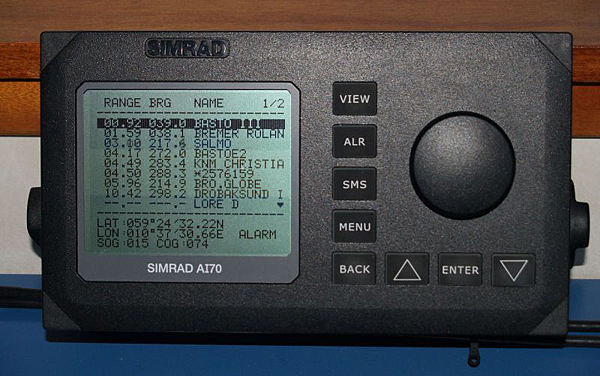
A vessel's text-only AIS display,
listing nearby vessels' range, bearings, and names
When a ship is navigating at sea, the movement and identity of other ships in the vicinity is critical for navigators to make decisions to avoid collision with other ships and dangers (shoal or rocks). Visual observation (unaided, binoculars, night vision), audio exchanges (whistle, horns, VHF radio), and radar or ARPA (Automatic Radar Plotting Aid) are historically used for this purpose. However, a lack of positive identification of the targets on the displays, and time delays and other limitation of radar for observing and calculating the action and response of ships around, especially on busy waters, sometimes prevent possible action in time to avoid collision.
While requirements of AIS are only to display a very basic text information, the data obtained can be integrated with a graphical electronic chart or a radar display, providing consolidated navigational information on a single display.

Each ship "mark" could reflect the actual size of the ship, with position to GPS or differential GPS accuracy. By "clicking" on a ship mark, you could learn the ship name, course and speed, classification, call sign, registration number, MMSI (Maritime Mobile Service Identity), and other information. Maneuvering information, CPA (closest point of approach), TCPA (time to closest point of approach) and other navigation information, more accurate and more timely than information available from an ARPA, could also be available. Display information previously available only to modern VTS operations centers could now be available to every AIS-equipped ship.
With this information, you could call any ship over VHF radio telephone by name, rather than by "ship off my port bow" or some other imprecise means.
The AIS is a shipboard broadcast system that acts like a transponder, operating in the VHF maritime band; that is capable of handling well over 4,500 reports per minute and updates as often as every two seconds. It uses STDMA (Self-Organizing Time Division Multiple Access) technology to meet this high broadcast rate and ensure reliable ship-to-ship operation.

IMO REQUIREMENTS
The requirements shall apply to all passenger ships, cargo ships of 300 gross tonnage and upwards engaged on international voyages and cargo ships of 500 gross tonnage and upwards not engaged on international voyages, as follows:
1. Ships constructed on or after 1 July 2002
2. All not later than 1 July 2002
AIS STANDARDS
ITU-R Recommendation M.1371-1 describes the following types of AIS:
Class A – Mandated on SOLAS Chapter V vessels (international voyaging ships of 300 or more gross tonnage).
Class B – A low power, lower cost derivative for leisure and non-SOLAS markets.
MAJOR ADVANTAGES
1. Automatic Identification of ships within VHF range.
2. Predict exact position of a meeting.
3. Predict minimum distance at bow crossing.
4. Identify vessels behind islands or a bend in a channel.
5. Obtain information about change in course over ground, heading and speed of ships nearby in
almost real time.
6. Short message communication over the data link.
HOW AIS WORKS
The AIS transponder normally works in an autonomous and continuous mode, regardless of whether it is operating in the open seas or coastal or inland areas. Transmissions use 9600 bit/s GMSK (Gaussian minimum shift keying) modulation over 25 or 12.5 kHz channels using the HDLC (High-level Data Link Control) packet protocol. Although only one radio channel is necessary, each station transmits and receives over two radio channels to avoid interference problems, and to allow channels to be shifted without communications loss from other ships. The system provides for automatic contention resolution between itself and other stations, and communications integrity is maintained even in overload situations.

STDMA BROADCAST MODE
Each station determines its own transmission schedule (slot), based upon data link traffic history and knowledge of future actions by other stations. A position report from one AIS station fits into one of 2250 time slots established every 60 seconds on each frequency. AIS stations continuously synchronize themselves to each other, to avoid overlap of slot transmissions. Slot selection by an AIS station is randomized within a defined interval, and tagged with a random timeout of between 0 and 8 frames. When a station changes its slot assignment, it announces both the new location and the timeout for that location. In this way, new stations, including those stations which suddenly come within radio range close to other vessels, will always be received by those vessels.

The required ship reporting capacity according to the IMO performance standard amounts to a minimum of 2000 time slots per minute, though the system provides 4500 time slots per minute. The STDMA broadcast mode allows the system to be overloaded by 400 to 500% through sharing of slots, and still provide nearly 100% throughput for ships closer than 8 to 10 NM to each other in a ship to ship mode. In the event of system overload, only targets further away will be subject to drop-out, in order to give preference to nearer targets that are a primary concern to ship operators. In practice, the capacity of the system is nearly unlimited, allowing for a great number of ships to be accommodated at the same time.

The system coverage range is similar to other VHF applications, essentially depending on The system coverage range is similar to other VHF applications, essentially depending on the height of the antenna, but slightly better due to digital VHF signal and not analog VHF signal. Its propagation is better than that of radar, due to the longer wavelength, so it’s possible to “see” around bends and behind islands if the land masses are not too high. A typical value to be expected at sea is nominally 20 nautical miles. With the help of repeater stations, the coverage for both ship and VTS stations can be improved considerably.

The system is backwards compatible with digital selective calling systems, allowing shore-based GMDSS systems to inexpensively establish AIS operating channels and identify and track AIS-equipped vessels, and is intended to fully replace existing DSC-based transponder systems.

Shore-based AIS network systems are now being built up around the world. One of the biggest fully-operational, real time systems with full routing capability is in China, operated by China MSA and delivered by Saab Transponder Tech in Sweden. The entire coastline is covered with approximately 150 base stations and 50 computer servers. Hundreds of shore based users, including CA 25 VTS centers, are then connected to the network and been able to see the maritime picture, but also to communicate with the ship with SRM (Safety Related Messages). All data is in real time and will full safety and security of ships and port facilities.

PHYSICAL LAYER


WHAT AIS BROADCASTS
A Class A AIS unit broadcasts the listed information every 2 to 10 seconds (depends on a variety of ship speed) while underway, and every 3 minutes while at anchor at a power level of 12.5 watts. The information broadcast includes:
1. Static:
IMO number (where available)
Call sign & name
Length and beam
Type of ship
Location of position-fixing antenna on the ship (after of bow and port or starboard of centerline)
2. Dynamic:
Ship's position with accuracy indication and integrity status
Time in UTC
Course over ground
Speed over ground
Heading
Navigational status (e.g. NUC, at anchor, etc. - manual input)
Rate of turn (where available)
Optional - Angle of heel (where available)
Optional - Pitch and roll (where available)
3. Voyage related:
Ship's draught
Hazardous cargo (type)
Destination and ETA (at Master’s discretion)
Optional - Route plan (waypoints)
4. Short safety-related messages
The different information types are valid for a different time period and thus need a different update rate:
Static information: Every 6 min and on request
Dynamic information: Depends on speed and course alteration according to below data refresh rate table
Voyage related information: Every 6 minutes, when data has been amended and on request
Safety-related message: As required
Data refresh rate table
Speed and course alteration rate | Data refresh rate |
At anchor | 3 minutes |
0 - 14 knots | 10 seconds |
0 - 14 knots & changing course | 3.3 seconds |
14 - 23 knots | 6 seconds |
14 - 23 knots & changing course | 2 seconds |
Over 23 knots | 2 seconds |
Over 23 knots & changing course | 2 seconds |
AIDS TO NAVIGATION
AIS was developed with the ability to broadcast positions and names of things other than vessels, namely it can serve to transmit navigation aid and marker positions. These aids can be located on shore, such as in a lighthouse, or on the water, on platforms or buoys. The US Coast Guard suggests that AIS might replace RACON, or radar beacons, currently used for electronic navigation aids.
The ability to broadcast navigation aid positions has also created the concept of Virtual AIS, also known as Synthetic AIS or Artificial AIS. The terms can mean two things; in the first case, an AIS transmission describes the position of physical marker but the signal itself originates from a transmitter located elsewhere. For example, an on-shore base station might broadcast the position of ten floating channel markers, each of which is too small to contain a transmitter itself. In the second case, it can mean AIS transmissions that indicate a marker which does not exist physically, or a concern which is not visible (i.e. submerged rocks, or a wrecked ship). Although such virtual aids would only be visible to AIS equipped ships, the low cost of maintaining them could lead to their usage when physical markers are unavailable.

VESSEL TRAFFIC SERVICES
For Vessel Traffic Services (VTS), the AIS means a revolution in enhanced surveillance and control of ships. The added functionality in the AIS enhances surveillance and control compared to what is possible with the traditional radar systems of today. All transponder targets within VHF radio distance are automatically displayed and identified on digital charts. The problem with influence of bad weather and target swapping in traditional radar systems, does not exist with the AIS technology.
The implementation of radar target broadcasting from the VTS further enhances the visibility of non AIS transponder equipped vessels, as radar targets from vessels not carrying AIS transponders may be sent out on the data link by the VTS. This means that ships equipped with AIS transponders also can see ships without transponders in areas covered by the VTS radar. This technology is now supported and under development by the VTS industry.

AIS PILOT PLUG
The AIS Pilot Plug can provide the means to enable pilots or shipboard crews to connect their own laptop PC or other portable device to the vessel’s AIS. Through by a software application which installed in notebook PC. It provides a graphic display of AIS targets onto electronic charts.

A major advantage of a pilot’s carry-aboard notebook PC is that it has software that meets the pilot’s specific needs and displays AIS and other information in a way that is most useful to the pilot. All AIS targets acquired by the ship’s AIS receiver displayed on the screen will have name flags and COG/Speed. By zooming in on a particular vessel, the footprint of the vessel can be seen. The pilot can call up information on that vessel on its icon or check any other vessel by pulling up the traffic window.
SEARCH AND RESCUE
For coordinating resources on scene of marine search & rescue operation, it is important to know the position and navigation status of ships in the vicinity of the ship or person in distress. Here AIS can provide additional information and awareness of the resources for on scene operation, even though AIS range is limited to VHF radio range. The AIS standard also envisioned the possible use on SAR Aircraft, and included a message (AIS Message 9) for aircraft to report position.

LIMITATIONS OF AIS
1. Automatic acknowledgement of ships reports by shore have not yet been addressed by the IMO.
2. The primitive data input will generate additional workload for the OOW. (and may usually neglected by OOW). Many AIS users are not updating their unit to accurately reflect voyage related information such as navigation status, static draft, destination, ETA, etc.
3. AIS data can be invaluable, however, as with any source of navigation information; it should not be solely relied upon in making navigational and collision-avoidance decisions.
4. The potential risk of mis-use AIS in collision avoidance. (There is not all ships carry AIS). The OOW should always be aware that other ships, in particular leisure craft, fishing boats and
warships, and some coastal shore stations including VTS centres, might not be fitted with AIS.
5. Many of you may probably supposed and many articles on AIS in the maritime presses all shows the ECDIS can overlaid with AIS vectors, but this is very misleading since the IMO currently no requirement for a vessel to be fitted with an ECDIS. It is well-known that the so-called “Minimum Keyboard Display,” the elementary three-line alphanumeric display required by the IMO, has severe limitations as a navigation tool. It is difficult and time-consuming to read. It is often mounted in inaccessible places. It takes a OOW away from essential navigation duties.
6. The OOW should always be aware that AIS fitted on other ships as a mandatory carriage requirement might, under certain circumstances, be switched off on the master's professional judgment.
7. For a pilot, some limitations in a vessel’s AIS set-up, particularly its display, can be avoided through the use of the pilot’s own carry-aboard electronic equipment. Through the pilot has a familiar display with data inputs and navigation software best matched to the local conditions.
AIS data in this environment has still some remaining limitations, and pilots need to be aware of these.
Nevertheless, many pilots have decided that the key to maximizing the benefits of AIS for the pilot’s job is accessing the data through the vessel’s pilot plug and displaying it on their own carry-aboard equipment.
SECURITY MEANS OR RISKS
AIS can automatically identifying your ship to VTS, vicinity ships, and coastal States, but it also reveal the same information to terrorists and pirates. Basic receiver units could be used to devastating effect in targeting high risk ships.
In its current form AIS could be used by a terrorist / pirate to send fake shore authority transmissions and divert shipping from its intended track and create AIS assisted ambush or ship wreck. No wonder some of the masters insist on the right to switch AIS off where the ship in high risk water areas.
At the high risk of terrorist / pirate attack water areas, the Master is facing the dilemma of exposing ship’s security risk to terrorists and pirates or make his vessel a terrorist suspect to coastal States?
But, will a master's decision to switch off the AIS immediately make his vessel a terrorist suspect? Particularly in territory water of United State. The USA's maritime surveillance stations requiring all vessels to keep AIS active at all times underway.
CONCLUSION
Reviewing the above comprehensive introduction of AIS transponder, the advantages for aspects of navigational aids, tools VTS surveillance, searched & rescues as well as security means are all depend on vessels had equipped with AIS transponder. But according to the IMO’s regulations, the mandatory requirements only apply to all passenger ships, cargo ships of 300 gross tonnage and upwards engaged on international voyages and cargo ships of 500 gross tonnage and upwards not engaged on international voyages.
In order to obtain the full benefits of AIS, there are some regulatory issues that still need to be addressed. One is given the established navigation safety value in “seeing” other vessels with AIS. It is important that navigator be able to “see” these vessels with AIS. These smaller vessels still present a navigation hazard for large vessels and, at least in the case of fishing vessels, are precisely the vessels that are most likely do not respond to VHF communications.
The other one is the AIS carriage requirements should be expanded more widely. As we know in coastal water areas or some high density traffic areas, the most risk for the large vessels is small vessels or fishing vessels where shuttling near by the vessel. Without AIS messages transmission, the small targets usually undetected below the radar beam, mistaken as waves or lost in vessel blind spots.
Thus no wonder for the navigation safety reason, the US Coast Guard hopes to extend the AIS carriage requirements in US waters to fishing vessels over 65 feet as well as passenger vessels carrying more than 50 passengers and towing vessels of more than 26 feet and 600 horsepower operating in all US waters. But however, the rule making has been delayed and put on a slow track because of opposition from the fishing, towing, and passenger ferry industries as well as other ship operating groups.
Another regulatory issue that has arisen is with a number of AIS vessels that do not have heading input to the AIS unit. According to my previous experience, many vessels with no or incorrect heading transmissions, the problem appears to be with a digital converter fitted on an old heading device to allow it to interface with the newer AIS equipment. This requires a fixed offset to be set at the converter, and sometimes this is done incorrectly by the installation engineer or is changed by the ship’s crew. Some vessels have other problems supplying heading for the AIS. Other vessels simply have no heading input to the AIS equipment. Whatever the problems, there exists some confusion about heading input requirements. Without going into the details of the conflicting interpretations of the requirements, this should be clarified and a heading input requirement clearly established and enforced.
Reference Materials:
The articles:
1. “Evaluation of the AIS Transponder Technologies for Vessel Traffic Service” by Feizhou Wang, issued by “The Institute of Navigation”.
2. “AIS The Next On-Board Necessity” by Stuart Reininger
3. “The Complete Guide to Automatic Identification Systems” by Leica Geosystems Inc.
4. “AIS: Safety or Danger?” issued by “SEAWAYS”.
5. Pilotage and the AIS pilot plug by Paul Kirchner, Captain Ted Kellogg and Jorge Viso.
The websites:
1. http://www.imo.org/ourwork/safety/navigation/pages/ais.aspx
2. http://www.navcen.uscg.gov/?pageName=AIS
3. http://en.wikipedia.org/wiki/Automatic_Identification_System


沒有留言:
張貼留言
請尊重智慧財產權
未經許可,禁止轉貼